What It Means to Be AI-Native
Using AI isn’t the same as being AI-native.
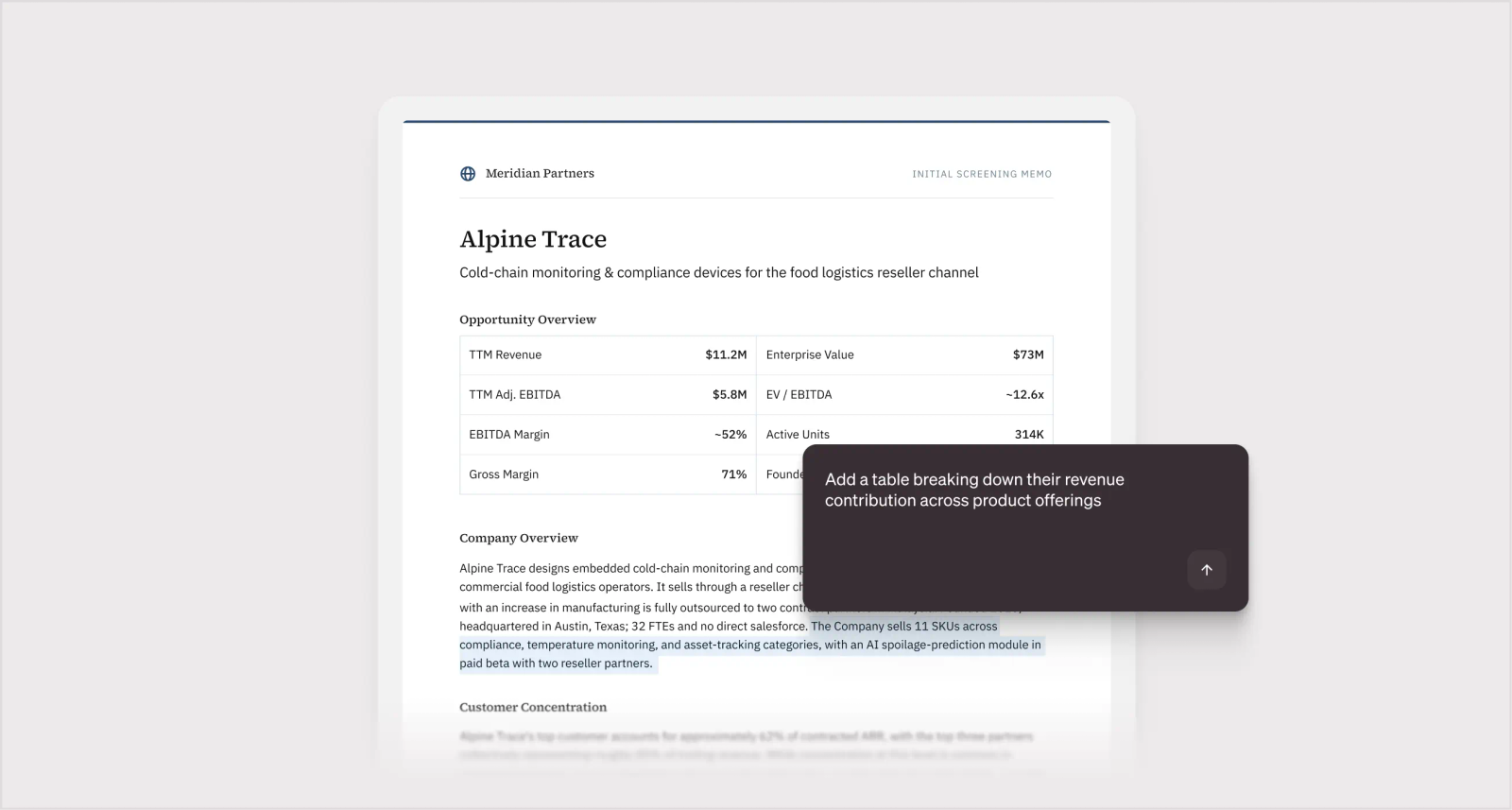


We just shipped Flexible Build, the latest update to Rubi’s Memo Builder. Before getting into what it does, I want to explain how we thought about building it.
At large, I believe many people conflate using AI with being AI-native.
Let’s take memo building as an example. If you’re using AI to build memos, you’re likely uploading a CIM, pasting in meeting notes, prompting the model to make it look visually accurate, and getting something that looks good enough to export to Word and make final edits.
But this version still requires you to be the engine, assembling the inputs at the beginning and fixing the outputs at the end. Moreover, this workflow breaks at scale because you’ll have to do it each time, from scratch, for every deal and every memo.
That’s not being AI-native.
Being AI-native is about where you show up in the process. It’s like having a really good analyst. Not one that you have to tell it what to do each time but one that knows your data, knows your processes, knows your templates, and brings you in only when it’s ready for your judgement and review.
The AI-native version of memo building looks like this.
From the moment a deal enters your pipeline, your AI is ingesting deal data — documents, emails, meetings, financials — and mapping everything to the deal. When it’s time for a memo, it generates as a step in a workflow, not because you manually triggered a prompt.
Additionally, you’re not spending any time making visual edits because the memo template is enforced as a deterministic output that is codified down to the pixel so that data and content pipe directly into it.
That’s what Rubi’s Memo Builder is built to be, and Flexible Build completes the picture.
With Flexible Build, the memo comes to you. You open the canvas, review the draft, and make whatever final additions this specific deal needs. Because Rubi already sits on top of all the deal data, you don’t need to track anything down. You simply say “add a customer concentration chart” or “add a new section comparing this to similar deals we’ve seen” and it’s rendered instantly, in your format, from your data.
You’re not at the beginning assembling inputs. You’re at the end, evaluating output and taking it the final mile. Your role is judgment. Everything mechanical happened before you got there.
Finally, this scales across memo types, deal volume, and team members because the data layer and the output format are both structured.
That’s what AI-native looks like in practice. It’s not a better prompt, but a different position in the process. The firms who get there will have built a system—a really good analyst—whose value compounds, leading to more deals, more consistency, and more of their team’s time spent on judgment instead of assembly.
If you want to see how this fits your firm’s process, we’d be happy to walk you through it.

